I Built a Soursop Bitters Formula, But the Interesting Part Is the Chemistry
had soursop leaves.
The obvious thing to do would have been to make tea.
So naturally, I decided to build a bitters formula instead.
Not because soursop needed to become something complicated, but because I wanted to explore it differently. A bitters formula is a small exercise in phytochemistry, sensory science, and restraint. I was not simply asking, What herbs taste good together? I was thinking about which compounds might be present, what alcohol may extract, how the flavors interact, and what happens to the safety conversation when multiple botanicals are combined.
My formulation started with soursop leaf as the botanical centerpiece, then I built around it with dandelion root, burdock root, orange peel, cinnamon, clove, cardamom, and fennel seed.
I am not sharing my exact recipe here. This post is about something I find much more interesting:
Why did each ingredient earn a place in the jar?
This is an educational discussion of botanical chemistry and formulation, not a treatment recommendation. Traditional use, laboratory activity, animal research, and proven clinical benefit are not interchangeable.
First, what exactly is a botanical bitters formula?
Bitters are not simply a collection of herbs that taste bitter.
A well-built formula has layers.
There is the botanical foundation. There are compounds that contribute bitterness. There are volatile aromatics. There may be citrus notes, warming spices, earthy roots, and ingredients that soften or extend the finish.
Then there is the solvent.
That matters because the compounds inside a plant do not all have the same chemistry. Some are highly water-soluble. Others are more soluble in alcohol. Many fall somewhere in between.
Solvent composition, particle size, extraction time, temperature, and the plant part itself can all influence what ends up in the final extract.
That means an herbal tea and an alcoholic extract made from the exact same plant should not automatically be treated as chemically identical.
Different solvent. Different extraction profile.
And that is where this experiment begins.
Soursop leaf: the botanical centerpiece
Soursop, Annona muricata, is one of those plants where traditional use and modern research exist side by side, but the distance between the two matters.
Phytochemical research has identified multiple classes of compounds in soursop, including Annonaceous acetogenins, alkaloids, flavonoids, phenolic compounds, and other secondary metabolites. Acetogenins have received considerable research attention because of their biological activity, but they are also central to the safety conversation surrounding frequent or prolonged soursop use. Much of the research on soursop remains preclinical, meaning it comes from laboratory or animal studies rather than strong evidence of safe, effective treatment in humans.
What it brings to the formulation
In my bitters, soursop is the botanical identity of the formula.
Its leaf profile gives the extraction a green, earthy, slightly tannic character. I did not want the stronger spices to completely overpower it, so every additional ingredient needed to either support, deepen, brighten, or connect the soursop to another part of the flavor profile.
The bioactive conversation
The acetogenins are where the science becomes particularly interesting.
These compounds have been studied for effects on cellular energy pathways, including mitochondrial function. But the same potent biological activity that makes them interesting to researchers is also why chronic exposure raises toxicological questions.
Reviews and risk assessments have identified unresolved concerns about potentially neurotoxic compounds in Annona muricata, particularly with prolonged or high exposure. The exact human risk at different doses and preparations is not well defined, which is precisely why I would not frame soursop bitters as a daily wellness tonic.
More is not automatically better.
Dandelion root: the bitter architecture
If soursop is the centerpiece, dandelion root, Taraxacum officinale, helps build the structure underneath it.
Dandelion contains a range of secondary metabolites, including phenolic compounds, flavonoids, terpenes, phytosterols, and other constituents. The exact profile varies by plant part and extraction method.
What it brings to the formulation
Flavor-wise, dandelion root gives me:
Earthiness. Roasted depth. Dry bitterness.
This is important because I did not want the formula to have one flat, aggressive bitter note.
Dandelion creates a deeper foundation. It gives the lighter, brighter aromatics something to push against.
In sensory terms, it creates contrast.
The interaction conversation
Dandelion is a good example of why food use and concentrated botanical extracts should not always be treated as equivalent.
People taking diuretics, glucose-lowering medications, anticoagulant or antiplatelet drugs, or those managing complex medication regimens should not assume that regular use of a concentrated extract is automatically inconsequential.
The evidence for many specific dandelion-drug interactions is limited, so I would not present every theoretical interaction as clinically proven. But limited evidence is not the same as proof that an interaction cannot occur.
People with allergies to plants in the Asteraceae family, which includes ragweed-related plants, should also be mindful of possible allergic reactions.
Burdock root: body, earthiness, and chemical complexity
Burdock, Arctium lappa, has a different job in this formula.
Its root contains inulin and other carbohydrates, phenolic acids, lignans, flavonoids, and additional secondary metabolites. Modern research has explored its antioxidant, inflammatory, metabolic, and microbiome-related properties, although much of the mechanistic evidence remains preclinical.
What it brings to the formulation
Burdock gives me:
Body. Rootiness. Mild sweetness. Earthy depth.
Dandelion gives the formula a more recognizable bitter edge.
Burdock rounds it.
That distinction matters because if every ingredient is screaming BITTER, the formula becomes exhausting rather than complex.
Burdock helps create the middle of the flavor profile. It fills the space between the deeper roots and the brighter aromatics.
The interaction conversation
Burdock is another botanical where strong claims about specific drug interactions would go beyond the available evidence.
Potential concerns are often raised around diuretics and glucose-lowering medications, but human interaction data are limited. Allergy is also possible, particularly in people sensitive to related plants.
Pregnancy, breastfeeding, significant kidney disease, and complex medication regimens are situations where concentrated multi-herb extracts deserve individualized review rather than generalized social media advice.
Orange peel: brightness through volatile chemistry
The roots pull the formula downward.
Orange peel brings it back into the light.
Sweet orange peel contains volatile aromatic compounds dominated by limonene, along with flavonoids such as hesperidin and other citrus polyphenols. Citrus peels contain multiple classes of bioactive compounds, including flavonoids, terpenes, carotenoids, and limonoids.
What it brings to the formulation
Bright. Zesty. Aromatic. Gently bitter.
Orange peel does more than make the formula taste citrusy.
The volatile oil fraction creates the first aromatic impression, while less volatile compounds in the peel contribute complexity beneath that initial burst of citrus.
From a formulation perspective, orange peel acts as a bridge. It lifts the earthy dandelion and burdock while connecting naturally with cinnamon, clove, cardamom, and fennel.
The extraction chemistry
Orange peel is especially interesting in a hydroalcoholic formula because it contains compounds with very different chemical properties.
The volatile aromatic fraction does not behave exactly like the more polar flavonoids and phenolic compounds.
So the solvent is not simply "soaking up orange flavor."
It is interacting with multiple chemical classes from the same plant material.
And importantly, sweet orange is not grapefruit. I would not apply the classic grapefruit CYP3A4 medication warning to this formula simply because it contains citrus peel.
Cinnamon: warmth with an aldehyde signature
Cinnamon contributes one of the most recognizable aromatic molecules in the entire formulation:
Cinnamaldehyde.
Depending on the cinnamon species and preparation, the chemical profile can also include polyphenols, volatile oils, and varying amounts of coumarin.
What it brings to the formulation
Warmth. Woody aromatics. Perceived sweetness.
Cinnamon does something interesting from a sensory perspective. It can make a formula feel sweeter and warmer even when very little actual sugar is present.
That makes it especially useful in a bitters formula.
The roots create darkness and depth. The orange peel creates brightness. Cinnamon creates warmth between them.
The interaction conversation
The cinnamon species matters.
Cassia cinnamon generally contains more coumarin than Ceylon cinnamon. Regular high exposure to coumarin can be a concern for the liver, particularly in people with liver disease or those taking medications that can also affect liver function.
Concentrated cinnamon products also deserve caution in people taking glucose-lowering medications, because additive effects are possible.
The evidence does not support treating normal culinary use and high-dose supplementation as though they are the same exposure.
Clove: a small ingredient with a loud chemical personality
Clove does not know how to whisper.
Its characteristic aroma is strongly associated with eugenol, a phenolic compound that gives clove its intense warm, pungent, almost numbing quality.
What it brings to the formulation
Warmth. Pungency. Sweet spice. Depth.
Clove helps connect the warmth of cinnamon with the brighter citrus notes.
But it can easily take over.
From a formulation standpoint, this is one of those ingredients where restraint matters. A small amount can create complexity. Too much and suddenly every other botanical disappears.
The interaction conversation
Concentrated clove and eugenol preparations deserve caution in people taking anticoagulant or antiplatelet medications, particularly when exposure is frequent or high.
This does not mean culinary clove automatically creates a clinically significant bleeding risk.
It means the form, concentration, amount, and frequency matter.
That distinction is essential in herbal formulation.
Cardamom: the aromatic bridge
Cardamom is one of my favorite ingredients in this formula because it connects things that could otherwise feel disconnected.
Its volatile chemistry can include compounds such as 1,8-cineole and alpha-terpinyl acetate, although the exact composition varies by species, origin, storage, and extraction method.
What it brings to the formulation
Floral. Fresh. Citrus-adjacent. Warm.
Cardamom sits between the orange peel and the darker spices.
Without it, the jump from citrus to cinnamon and clove could feel abrupt.
With it, the aromatic profile has a bridge.
This is what I mean when I say formulation is about more than asking what each herb is "good for."
Sometimes an ingredient earns its place because of what it does to the entire sensory system.
Fennel seed: sweetness without turning the formula into syrup
Fennel's characteristic aroma is strongly associated with anethole, along with other volatile compounds.
What it brings to the formulation
Soft sweetness. Anise. Warm aromatics.
Bitterness needs contrast.
Fennel softens the edges of the roots and spices and can make the formula feel sweeter without requiring the same amount of added sugar.
It also extends the finish. The bitterness does not simply stop. It transitions into a softer aromatic note.
The interaction conversation
Fennel preparations deserve additional consideration in people with hormone-sensitive conditions because some of its constituents, particularly anethole-related compounds, have been investigated for estrogenic activity.
The clinical significance depends heavily on the preparation, concentration, and dose.
That is not a reason to panic over culinary fennel.
It is a reason not to pretend that every concentrated botanical preparation is pharmacologically inert.
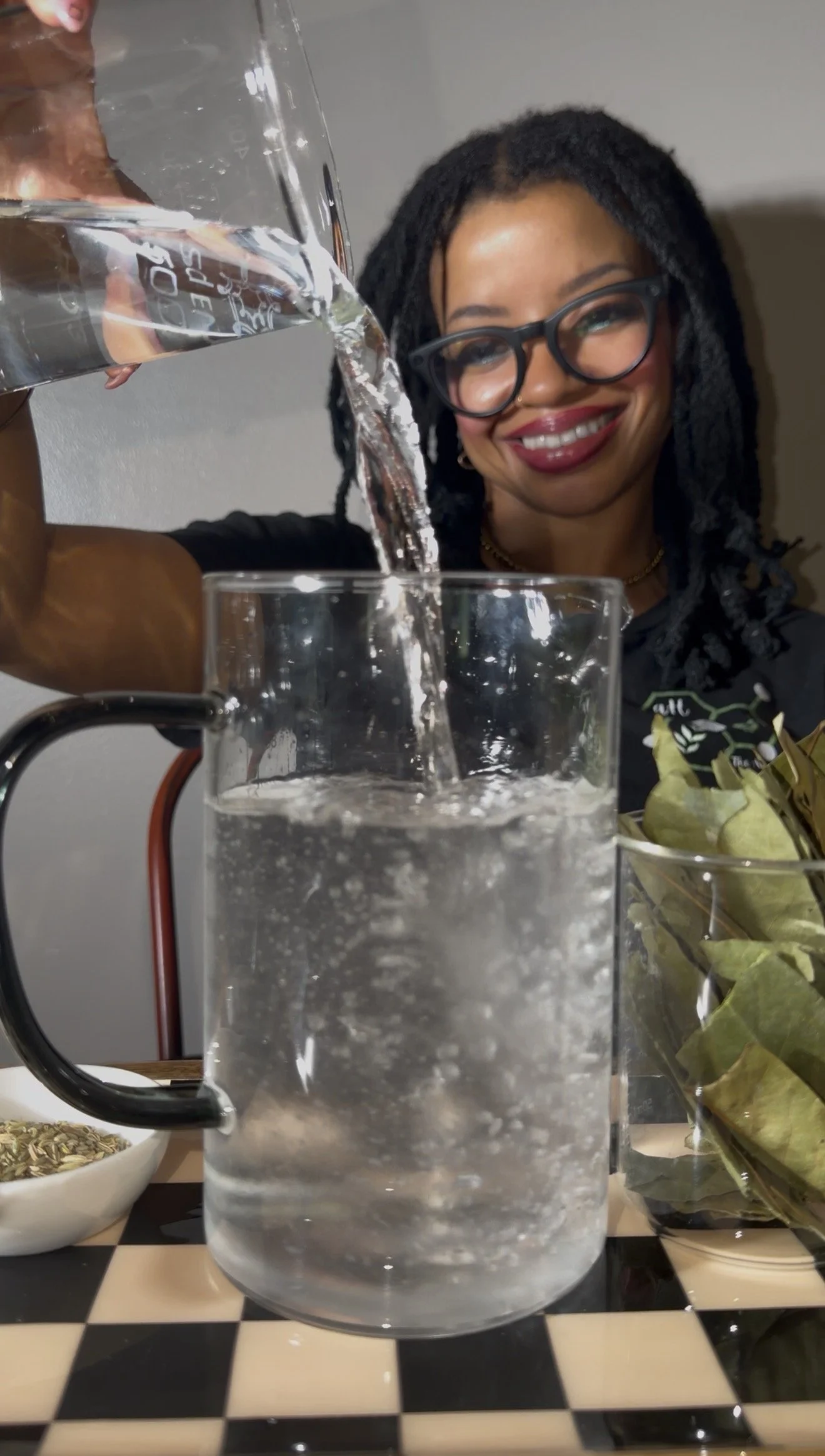
the solvent
Alcohol + Distilled Water
The most important ingredient may be the solvent
This is the part that fascinates me most.
Alcohol is not just there for preservation.
It is an extraction variable.
Plant molecules vary in polarity and solubility. Water is better at extracting some compounds. Ethanol improves the extraction of others. A hydroalcoholic system can therefore produce a different chemical profile than a simple tea.
But "broader extraction" should not automatically be translated into "better."
It means different.
And potentially more concentrated.
The solvent changes the experiment.
Now for the part people skip: the ingredients do not exist in isolation
When I combine multiple plants, I do not assume the final formula is simply:
Plant A + Plant B + Plant C.
A multi-botanical extract is chemically more complicated than that.
Compounds can potentially produce additive, synergistic, or antagonistic effects. One constituent may affect another compound's absorption, metabolism, stability, or biological activity.
And the truth is that this exact combination has not been thoroughly studied in humans.
That matters.
In this formulation, several safety conversations may overlap. Soursop brings unresolved concerns around chronic acetogenin exposure. Cinnamon may be relevant to glucose regulation and coumarin exposure depending on the species. Clove raises questions around concentrated eugenol exposure and bleeding risk. Fennel adds a hormone-sensitive consideration. The roots bring their own theoretical medication and allergy concerns.
This does not mean the formula is automatically dangerous.
It means the safety of a multi-herb preparation cannot be proven by saying:
"Every ingredient is natural."
That is not a safety assessment.
Who should be especially cautious?
I would want individualized medical or pharmacy guidance before using a concentrated multi-herb bitters preparation if someone:
takes multiple prescription medications
uses anticoagulant or antiplatelet drugs
takes blood pressure or glucose-lowering medication
has liver or kidney disease
has a neurological disorder
has a hormone-sensitive condition
is pregnant or breastfeeding
is preparing for surgery
has significant plant allergies
And because this particular formulation contains soursop leaf, I would not frame it as a daily tonic or encourage chronic high-dose use.
Concerns surrounding acetogenin exposure are one reason I think occasional bitters use and habitual medicinal dosing should be treated as different conversations.
My formulation philosophy
The goal was never to cram the largest possible number of "healthy" herbs into one jar.
The goal was balance.
Soursop gave me the botanical identity.
Dandelion gave me bitter structure.
Burdock gave me body.
Orange peel gave me brightness.
Cinnamon and clove gave me warmth.
Cardamom built a bridge between the citrus and spice.
Fennel softened the edges.
And the solvent?
The solvent turned a collection of dried plants into an extraction experiment.
That is the part of herbalism I love most.
I do not have to choose between tradition and science.
I can respect the traditional relationship humans have had with plants while still asking modern questions about phytochemistry, extraction, dose, interactions, toxicity, and evidence.
Because a beautiful jar can still deserve a critical eye.
And sometimes the most interesting question is not:
"What is this herb good for?"
It is:
"What chemistry did I just put together, and what does the evidence actually allow me to say about it?"
Educational content only. This formulation is not intended to diagnose, treat, cure, or prevent disease. If you take medication or have a medical condition, discuss concentrated botanical products with a pharmacist or qualified healthcare professional before use.